

Read the delivery basis first
A contractor may receive IFC alongside drawings, specifications, schedules, and tender clarifications. Before relying on a model, identify its contractual status, revision, intended use, and relationship to other documents. A model supplied for information can still help a team understand complexity, but it may not control if conflicts arise.
Record the applicable precedence rules and questions for formal clarification. This prevents useful visualization from becoming an unsupported assumption about scope, dimensions, or approved design.
Use models to improve understanding
For a hypothetical highway package, a federated IFC can help the tender team inspect how a bridge, drainage, retaining structures, and traffic staging relate spatially. It may expose access constraints or an interface that is difficult to infer from separate drawings.
The model is a navigation aid for asking better questions, not a replacement for detailed review. Compare critical conditions with controlled drawings and specifications. If a dimension or material is commercially significant, verify it against the authoritative source before pricing or procurement.
Treat quantities as measured estimates
IFC quantities can accelerate early estimating, but their reliability depends on object scope, classification, measurement method, and model maturity. Check sample quantities against drawings or independent takeoffs. Identify whether the file includes temporary works, waste allowances, construction joints, reinforcement, or only design geometry.
A concrete volume from a model may exclude laps, overbreak, or pour sequencing assumptions. Label extracted data with its source revision and limitations. Do not represent a model-derived number as a contractual quantity unless the project expressly authorizes that use.
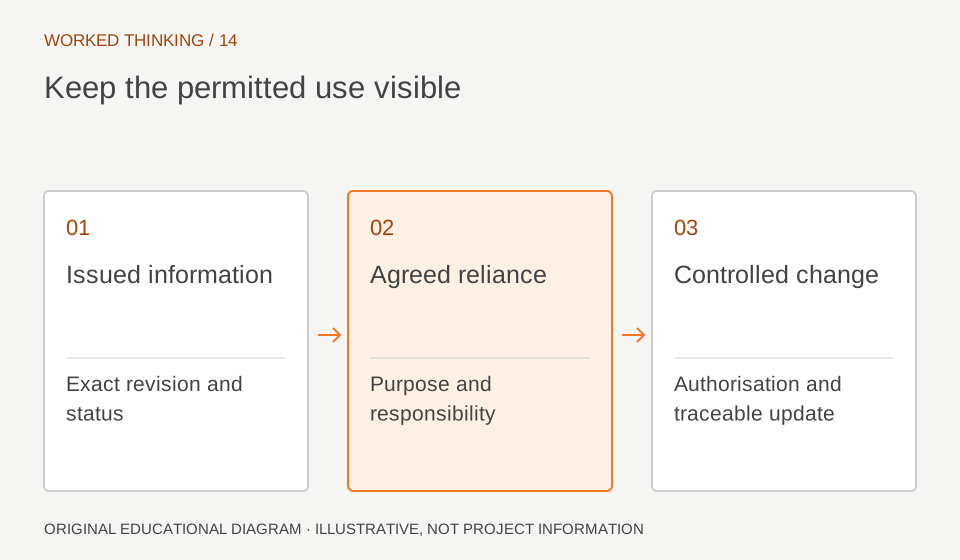
Read diagram notes
- Issued information
- Exact revision and status
- Agreed reliance
- Purpose and responsibility
- Controlled change
- Authorisation and traceable update
Coordinate interfaces around work
Construction coordination should ask what crews need to build safely and in sequence. Review clearances, lifting access, temporary supports, installation tolerances, and sequence dependencies where they affect the work package.
A clash between a structural member and a service may be a design conflict, but a model can also reveal a logistics constraint such as an access route blocked by staged materials. Route design changes to the responsible designer. Contractor planning insight should inform the decision without silently changing the approved structural design.
Connect issues to site questions
A field observation should identify the location, model revision, observed condition, and requested response. If a setting-out check suggests a foundation differs from the design surface, preserve the survey reference and measurement date. Open an issue or formal request that points to the evidence and affected elements.
The designer should confirm whether a change is needed. Avoid asking crews to resolve model discrepancies by improvising offsets or cutting openings; the issue workflow must preserve safety and technical authority.
Use 4D as a planning conversation
Linking model elements to activities can reveal sequencing conflicts, work-space competition, and temporary access needs. For example, a bridge deck closure plan may need to coordinate girder placement, concrete works, utility installation, and traffic management. A 4D simulation is only as credible as the schedule logic and model grouping.
Confirm that activities have realistic durations and dependencies and that the visual sequence reflects the construction method. Use it to test assumptions with site teams, not to promise a date unsupported by the approved programme.
Keep procurement data traceable
If model quantities or classifications feed procurement, preserve the chain from model revision to takeoff, package, and purchase order. Check whether each item represents a supply unit, installed object, or design placeholder. A model object can be counted twice when parts, types, and assemblies coexist.
Have procurement specialists and engineers review categories that affect safety or specification. Where the model is incomplete, use an explicit reconciliation rather than silently filling gaps with assumptions.
Build a controlled field workflow
Site teams need a clear way to access approved information, report discrepancies, and identify superseded versions. Configure offline or mobile access to suit actual site conditions and train users to verify status before relying on a view.
The model's usefulness is strongest when it sits beside drawings, method statements, inspections, and survey data in a controlled process. Capture field feedback so as-built records can be improved, but retain the evidence and approval trail that explains each accepted change.
Create a short use register for field teams that names approved sources, prohibited assumptions, and the contact for resolving conflicts. Review it during mobilization and after major revisions.