
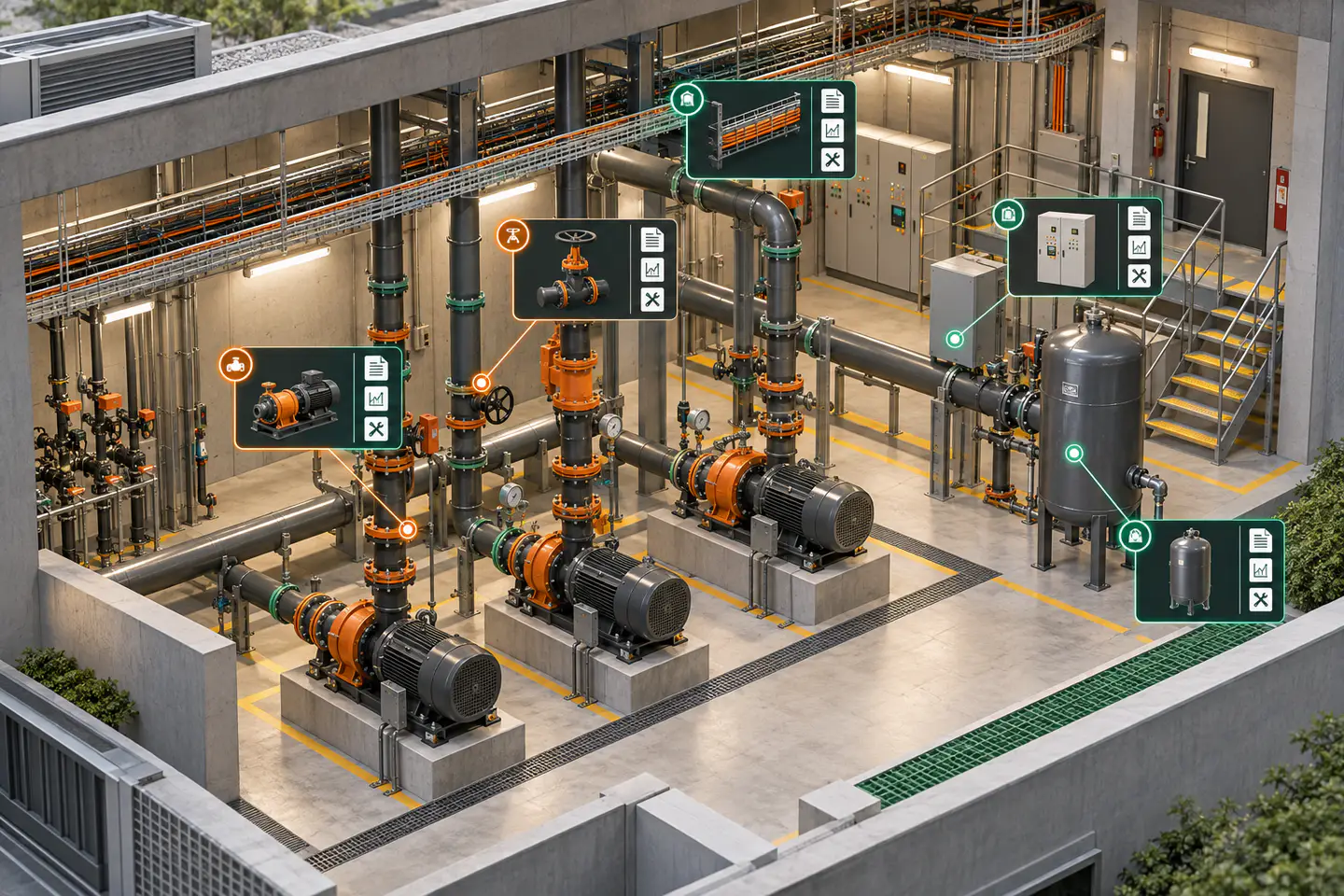
Start from maintenance tasks
Ask a maintainer what needs to be found during inspection, isolation, replacement and planned maintenance. Translate those tasks into asset identity, location, system parent, status, document and spare-part information.
Use stable identity
Give each maintainable asset an identifier that survives a model re-export and relate it to a system and location. Do not depend on an element’s temporary authoring ID or a colour in a view.
Link evidence, not just fields
Connect approved manuals, test records, warranties or product data through a controlled document reference. A URL without status and revision can lead the operator to a superseded document.
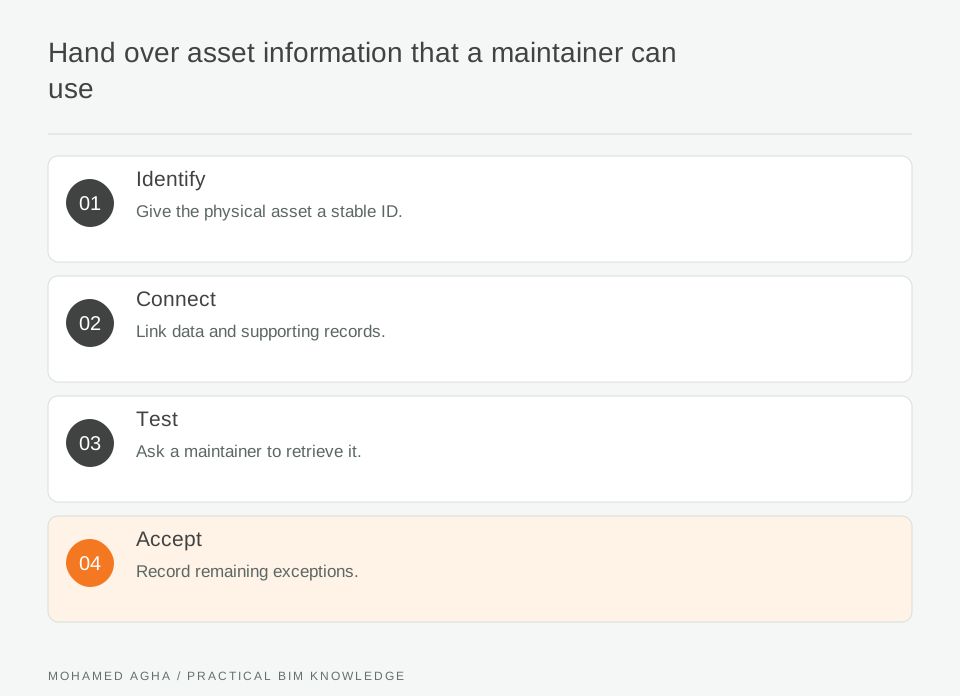
Read diagram notes
- Identify
- Give the physical asset a stable ID.
- Connect
- Link data and supporting records.
- Test
- Ask a maintainer to retrieve it.
- Accept
- Record remaining exceptions.
Test the handover journey
On one system, ask a future user to locate an asset, identify its parent system, confirm the source of its data and retrieve the required document. Time spent in this trial exposes unusable structure.
Handle unknowns visibly
Use an agreed unknown or pending status instead of copied placeholder values. The owner can then see which information requires supplier confirmation without mistaking a blank for completed data.
Package the acceptance evidence
Deliver the asset sample, property rule, linked documents, exception list and recipient test result. This is an information acceptance record; it does not certify equipment performance or commissioning.
Worked example: a chilled-water pump handover
For one pump, the team creates an asset ID, room location, system relationship and controlled link to the approved manual. The maintainer starts from a planned inspection task, finds the physical pump in the model, opens the manual and sees that the warranty record is still pending. The handover does not hide that gap: it becomes an owned action. This trial also finds that two pumps used the same supplier tag, so the asset register is corrected before the system is copied to other rooms. Inputs include equipment schedule, approved documents and the model’s plant-room view. The mismatch is that a pump has a location and manual but no system parent, so the maintainer cannot understand its operational context. The author links the asset to the chilled-water system and retests retrieval. The output is an asset acceptance sample that exposes remaining supplier information without inventing it.
Handover checklist
Give each asset a stable ID; relate it to room and system; link controlled documents; state approval status; test retrieval with a maintainer; retain pending values and owners.