
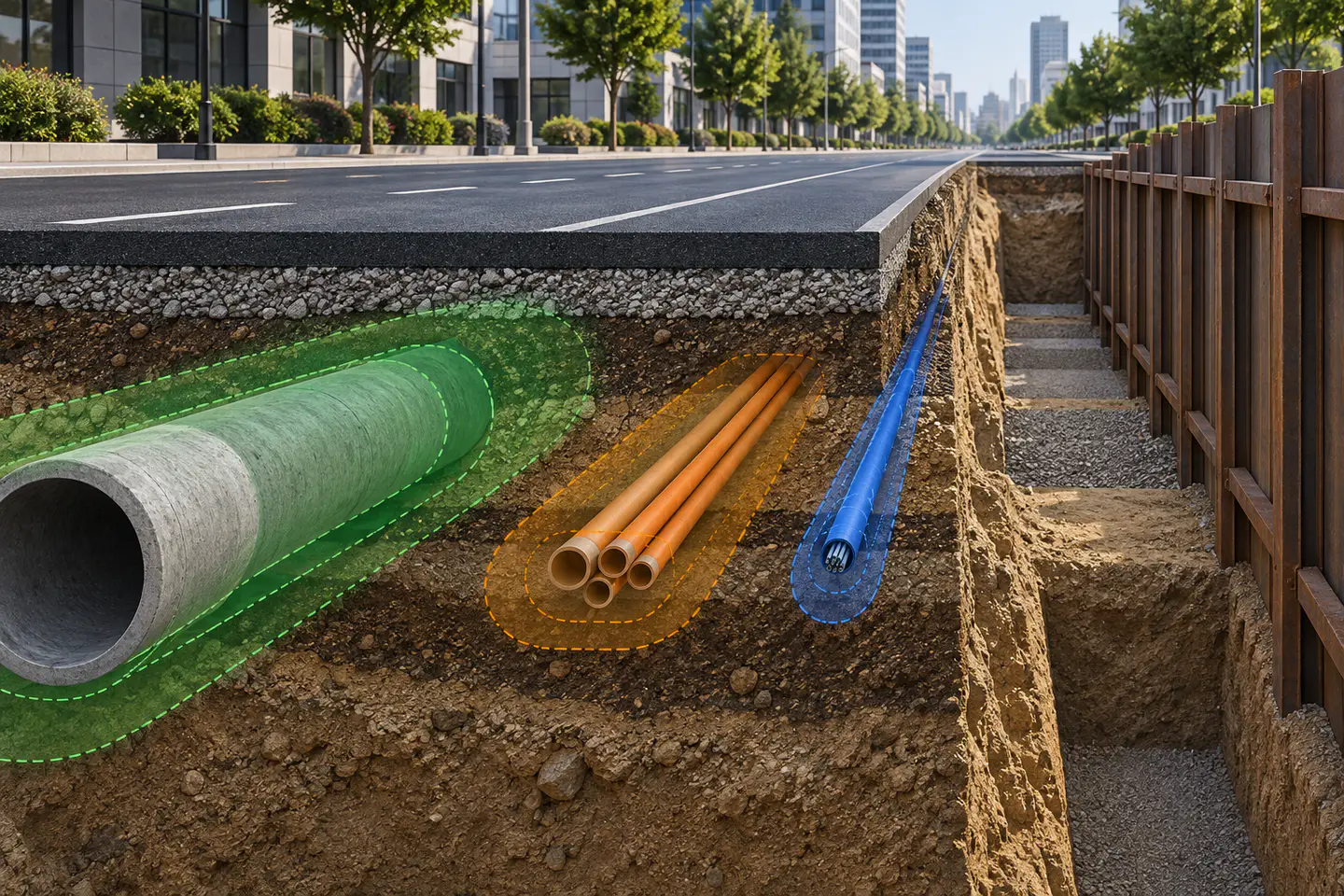
Separate evidence types
Classify utility geometry by its source: record information, survey detection, verified exposure or design assumption. A model line should never imply the same confidence regardless of its provenance.
Preserve dates and conditions
Utility records age and site conditions vary. Store source date, method, coordinate basis, responsible provider and any stated limitations so the next reviewer understands what was actually known.
Show uncertainty deliberately
Use an agreed graphical or data convention for confidence and positional uncertainty. Do not translate a broad investigation area into a precise pipe centerline merely to make a federated model look orderly.
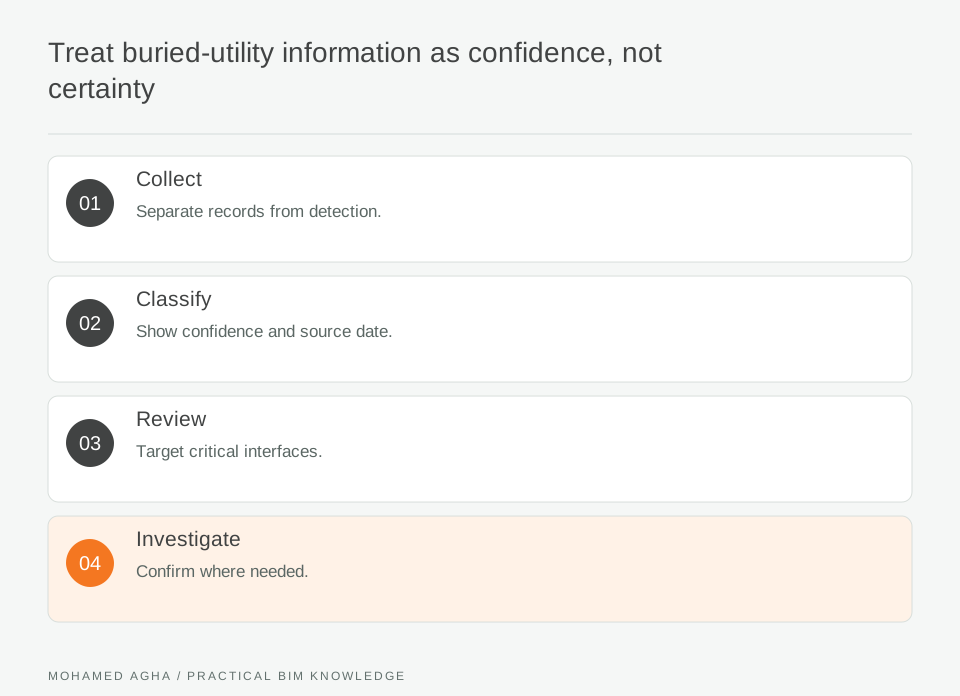
Read diagram notes
- Collect
- Separate records from detection.
- Classify
- Show confidence and source date.
- Review
- Target critical interfaces.
- Investigate
- Confirm where needed.
Review excavation interfaces
For a wall, foundation or crossing, identify the relevant utilities and evidence rather than declaring a generic clearance. The accountable team decides what investigation and safe method are required.
Test field return
Ask a field user to locate the source record from the model and identify what additional confirmation is required. If the result is unclear, improve the information structure before relying on it in planning.
Avoid false closure
A clash-free model is not proof that buried services have been found or that work is safe. Keep the confidence register and investigation actions open until the responsible process confirms them.
Worked example: retaining-wall excavation review
Before a retaining-wall package, the civil team combines record drawings, a detection survey and two verified exposure records. Each utility is tagged with source, date and confidence description. The view shows an uncertain cable corridor rather than a falsely precise centerline. The team identifies the wall zone where evidence is incomplete and raises an investigation action. The BIM coordinator records the interface but does not declare clearance. The accountable construction and utility processes decide what confirmation and safe work arrangements are necessary. Inputs include statutory records, detection results, exposure logs and the proposed wall line. The mismatch is that the record drawing and detection corridor do not agree near the excavation. Instead of averaging them into one line, the team retains both evidence types and opens an investigation action at the interface. The output is a confidence register and review view that clearly distinguishes unknowns from confirmed observations.
Utility-information checklist
Separate records, detection and exposure; store source date and basis; represent uncertainty; review critical interfaces; link investigation actions; never use a clash-free view as proof of safe clearance.