
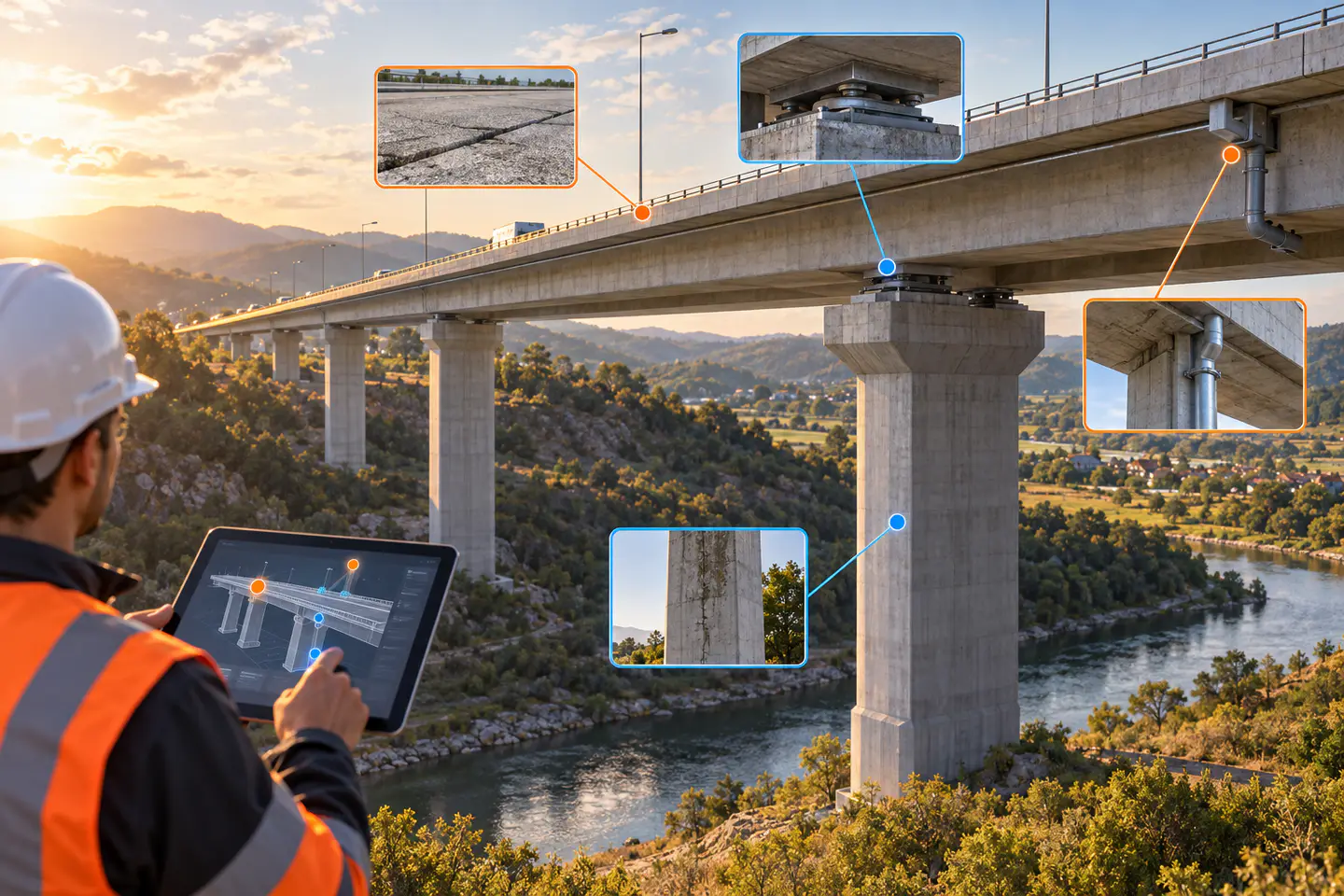
Choose inspection-scale objects
Define which components deserve individual IDs: bearings, expansion joints, parapets, drainage outlets, piers or deck zones. Match the breakdown to how inspections and maintenance work are actually recorded.
Relate IDs to location
Connect each identifier to span, pier, route or chainage reference and a discoverable model location. Test a person’s ability to find it from an inspection form and from the model in both directions.
Avoid visual-only references
Descriptions such as “near the left abutment” become ambiguous as views rotate or packages change. Use stable identifiers and agreed orientation or route conventions in every system.
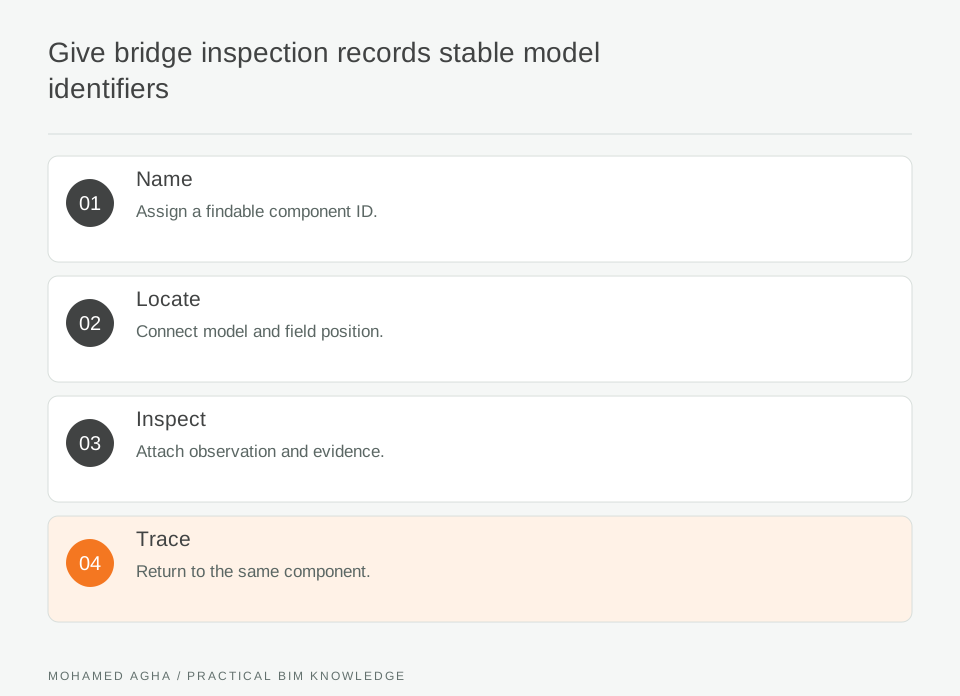
Read diagram notes
- Name
- Assign a findable component ID.
- Locate
- Connect model and field position.
- Inspect
- Attach observation and evidence.
- Trace
- Return to the same component.
Capture evidence and status
An inspection record should carry date, inspector, observation, photographs or documents, condition status and any follow-up action. Keep observed condition distinct from a recommended repair.
Test a live sample
Select several components across different spans and ask the inspection team to create and retrieve records. Resolve duplicates, missing objects and unfindable locations before scaling the taxonomy.
Maintain identity through change
When a component is replaced or split, record the relationship to the prior ID rather than reusing it without history. This protects the audit trail while allowing the model to evolve.
Worked example: inspect bridge bearings by component ID
A bridge team selects one span for a trial. Each bearing, joint and drainage outlet receives an ID linked to span and pier references. On site, an inspector enters an observation against a bearing ID and attaches a photo. Back in the model, another reviewer finds the same component from the record without relying on a camera direction. The trial exposes two legacy bearing labels that are not unique, so the mapping table preserves the old labels while the new controlled IDs are adopted. Inputs are a component register, span drawing and field inspection form. The mismatch is that a drainage outlet is identifiable on a drawing but has no corresponding model object. The team agrees a suitable inspection-level object and maps the field label to its new controlled ID. The output is a two-way lookup test that proves inspectors and coordinators reach the same component.
Inspection-ID checklist
Match object breakdown to maintenance practice; tie IDs to span and route reference; test lookup both ways; attach observation evidence; control replacements; preserve the relationship to older IDs.