
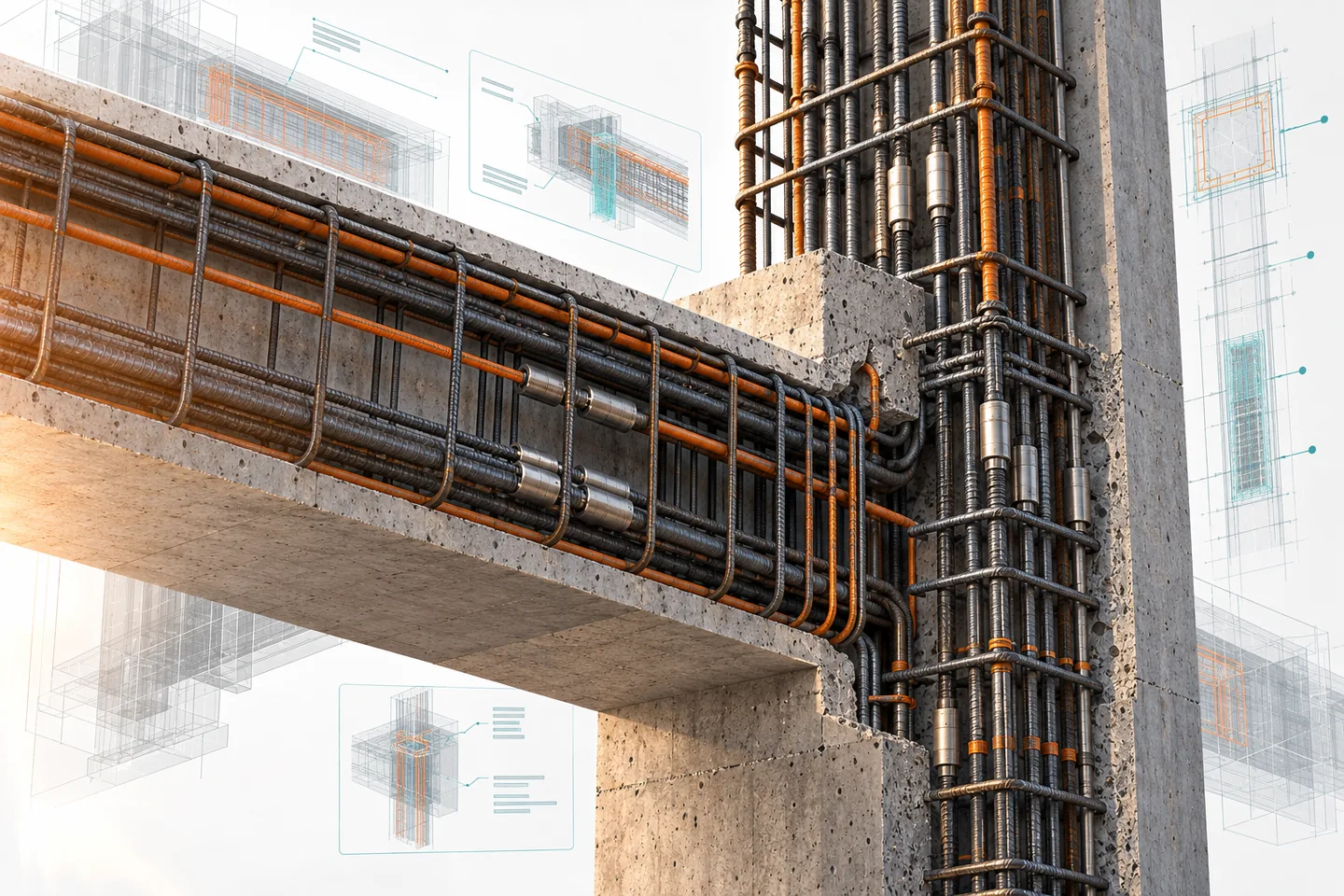
Choose a congestion zone
Start with a condition that is genuinely difficult to assemble, such as a deep transfer beam entering a heavily reinforced column. The purpose is not to prove reinforcement capacity. It is to make potential congestion, access and sequencing visible early enough for the design and detailing teams to consider them.
Read the model as a visual check
Review bar paths in plan, elevation and section. Look at cover zones, hooks, laps, couplers, starter bars and the space needed for placing concrete. A clean rendering can hide bars on different planes, so isolate sets and inspect their actual relationship rather than relying on a transparent overall view.
Check sequence as well as shape
Ask how the detail might be installed: which bars arrive first, where a coupler is operated, and whether an intersection blocks a realistic placing path. These questions identify a constructability risk; they do not select a revised bar arrangement. Preserve the original detail and label any proposed alternative as a question for the responsible designer.
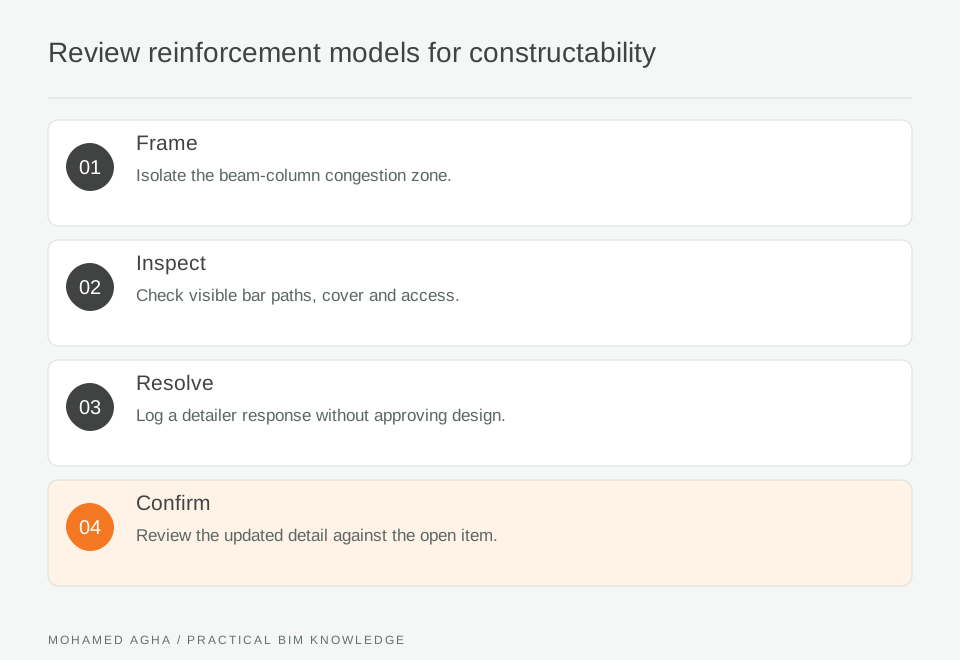
Read diagram notes
- Frame
- Isolate the beam-column congestion zone.
- Inspect
- Check visible bar paths, cover and access.
- Resolve
- Log a detailer response without approving design.
- Confirm
- Review the updated detail against the open item.
Expose unresolved substitutions
When a model uses generic bars or simplified bends, say so. Do not let a coordination family silently stand in for a fabrication-ready bar schedule. Record missing bend radii, cover requirements, bar marks or material data as information gaps rather than guessing values.
Follow a coupler-access question
In a transfer-zone trial, two bar sets appear separated in a transparent 3D view, yet a section exposes a coupler close to the path used to install an adjoining bar. Record the relevant bar marks, host and model revision. Ask the detailer to explain the intended installation sequence and the designer to address any proposed change to the arrangement. Keep the query open if the model uses a simplified coupler family whose dimensions are unconfirmed. Once the accepted response is incorporated, inspect the same section and compare the affected schedule entries. Also communicate any changed envelope to the team coordinating embedded services. The result is a traceable constructability discussion; it is not a claim that the visualization itself approves reinforcement or installation safety.
Use detailer feedback correctly
The detailer can respond with a marked view, proposed sequence or revised model. Log which response was accepted and by whom. A coordinator should ensure the response reaches affected MEP and architectural interfaces, while the design authority retains approval of structural detailing.
State the limit of the review
Close the item only when the agreed response is traceable to the reviewed location and version. A model review cannot establish code compliance, concrete placement safety, bar bending feasibility at every scale or the adequacy of the design calculation.