

Follow the quantity into the calculation
AEC Magazine reports on guidance for embodied-carbon calculations associated with BIM objects. For a structural BIM team, an important contribution is the reliability of the quantity and its mapping to an appropriate material record. This article proposes an independent input-review workflow. It is not a complete life-cycle assessment method, and the numerical illustration uses invented values solely to demonstrate unit checking.
Define the comparison boundary
Identify which structural elements and life-cycle stages are included before collecting quantities. Keep exclusions visible: foundations, reinforcement, temporary works or finishes should not disappear into an unlabeled total. Record whether the exercise compares design options or estimates a defined project scope. Options with different included elements cannot be compared fairly simply because both produce a number in kilograms of carbon dioxide equivalent. The assessment lead should agree the comparison basis.
Choose a quantity with an auditable origin
Extract quantities at a level that can be traced back to model objects, revision and material assignment. Review a small sample independently using dimensions or another appropriate check. Record how openings, joins and overlapping objects affect the quantity. Separate modelled objects from manual allowances. An allowance can be reasonable, but its origin should remain visible so that it is not counted again when the corresponding geometry is later added.
Read diagram notes
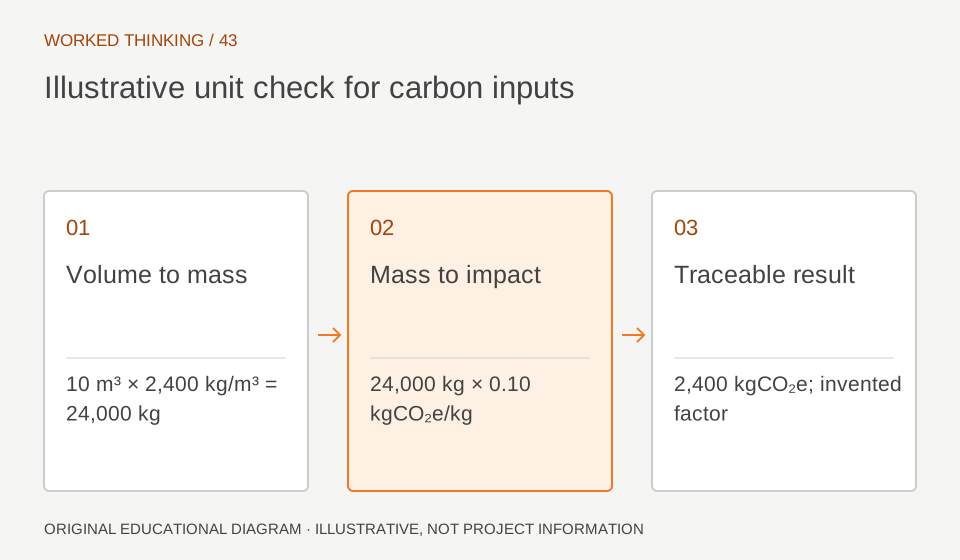
- Volume to mass
- 10 m³ × 2,400 kg/m³ = 24,000 kg
- Mass to impact
- 24,000 kg × 0.10 kgCO₂e/kg
- Traceable result
- 2,400 kgCO₂e; invented factor
Use dimensional consistency as a first check
If a factor is expressed per kilogram of material, a volume cannot be multiplied by it directly. In a purely illustrative example, 10 cubic metres multiplied by an assumed density of 2,400 kilograms per cubic metre gives 24,000 kilograms. Multiplying that mass by an invented factor of 0.10 kilograms CO₂e per kilogram gives 2,400 kilograms CO₂e. These are not recommended design or carbon factors. The example demonstrates the cancellation of units, not the performance of a real concrete product.
Review the material mapping
A generic model material name may not identify the product represented by an environmental declaration or other factor source. Keep the model name, mapped factor, factor unit, source, date and included stages in a mapping table. Flag unmatched or ambiguous records for review. Do not choose a convenient factor just to make every row calculate. A visible gap is preferable to a precise-looking result based on an unsupported material match.
Show uncertainty beside the result
Distinguish measured model quantities, provisional allowances and unconfirmed material selections. Where appropriate, the assessment specialist can examine how these uncertainties affect the comparison. Avoid reporting more numerical precision than the inputs justify. When a design change reduces concrete volume but changes another component, review the whole agreed boundary rather than celebrating one isolated reduction. Model quantity quality and assessment quality are related, but they are not the same acceptance decision.
Package a reproducible input set
Save the model revision, extraction rules, quantity schedule, mapping table and exception register together. Assign a reviewer to unresolved items and record the accepted scope. The BIM deliverable should let another person reproduce where the quantities came from and understand what they exclude. That creates a dependable basis for the carbon specialist’s assessment and makes later option changes easier to explain.